
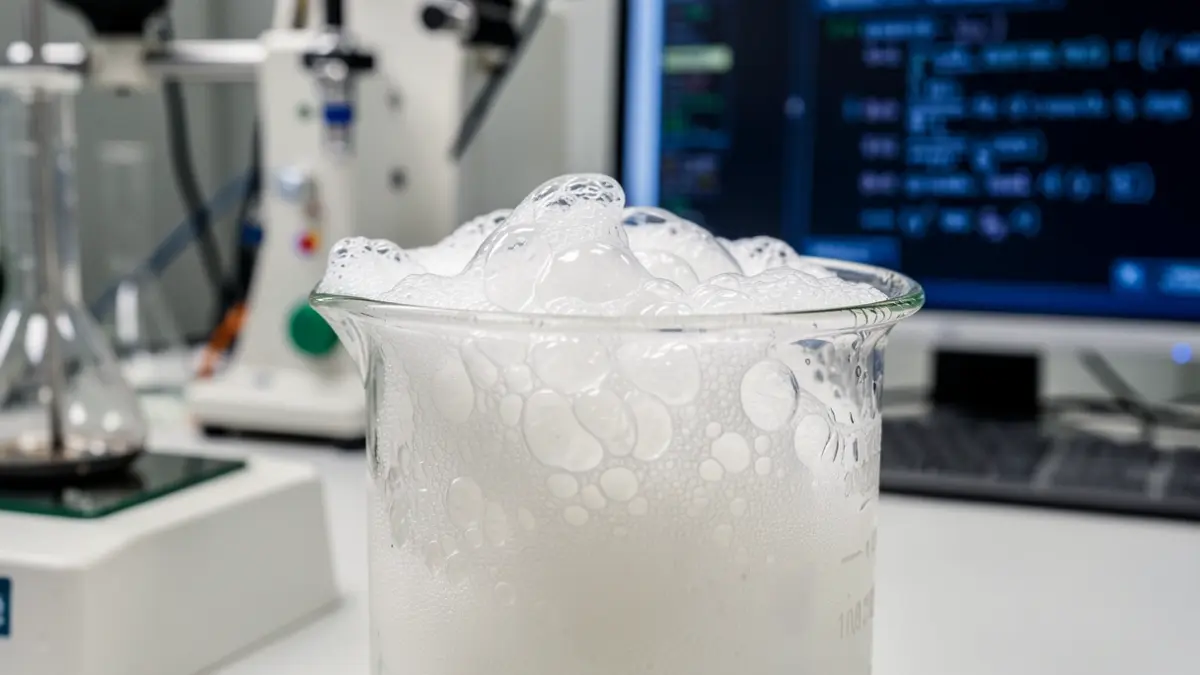
The ability to predict the amount of foam produced by a formulation is a major challenge for industries in various sectors, including food (chocolate mousse), cosmetics (shaving foam), and safety (firefighting foam). Until now, existing models struggled to generalize their predictions to molecules or processes other than those for which they were specifically designed.
A collaboration between four French laboratories – UMET (CNRS, INRAE, Université de Lille, Centrale Lille), TIMR (UTC/ESCOM, Compiègne), SayFood and MIA-PS (INRAE, AgroParisTech, Université Paris-Saclay), and the Laboratoire de Génie Chimique (Toulouse INP, CNRS) – presents a new approach published in the journal Chemical Engineering Journal. Their innovation relies on considering dynamic surface tension, which measures the speed at which surfactant molecules move to newly created interfaces, rather than equilibrium surface tension, deemed insufficient for describing rapid foaming.
After conducting 130 foaming experiments on about ten representative surfactants, researchers applied dimensional analysis to integrate time-dependent physical quantities. An artificial intelligence, using symbolic regression, then determined the most suitable equation form. This method results in a single predictive correlation for each process, capable of predicting foam height for all tested surfactants with remarkable accuracy (R² of 0.90 and 0.96), significantly outperforming classical approaches (R² of 0.73 and 0.75).
These predictive models pave the way for reducing costly trial campaigns, optimizing foaming processes, and selecting suitable surfactants. The researchers foresee the emergence of a new field: the 'science of dynamic interfaces,' which would describe interface properties by their temporal evolution rather than static constants.