The preservation of the Thau Lagoon's seagrasses no longer limits itself to public awareness. For over ten years, the Thau Basin Mixed Syndicate (SMBT) has been accompanying local authorities, professionals, and users to adapt their practices. This approach has fostered collective awareness, now shared with other coastal territories.
Elected officials, naturalist experts, and technicians, notably from the municipalities of Le Grau-du-Roi, Pérols, and La Grande-Motte, from Sète agglopôle méditerranée and the SMBT, gathered to exchange on practices that reconcile recreational activities with seagrass preservation. After a presentation of the measures taken, participants witnessed a demonstration on the beach dedicated to the reasoned management of plant deposits.
This meeting addresses a problem also encountered in Le Grau-du-Roi, where the development of dwarf eelgrass seagrasses on certain beaches raises questions about their coexistence with recreational uses. The experience in Balaruc-les-Bains thus constitutes a valuable feedback for coastal municipalities facing similar situations.
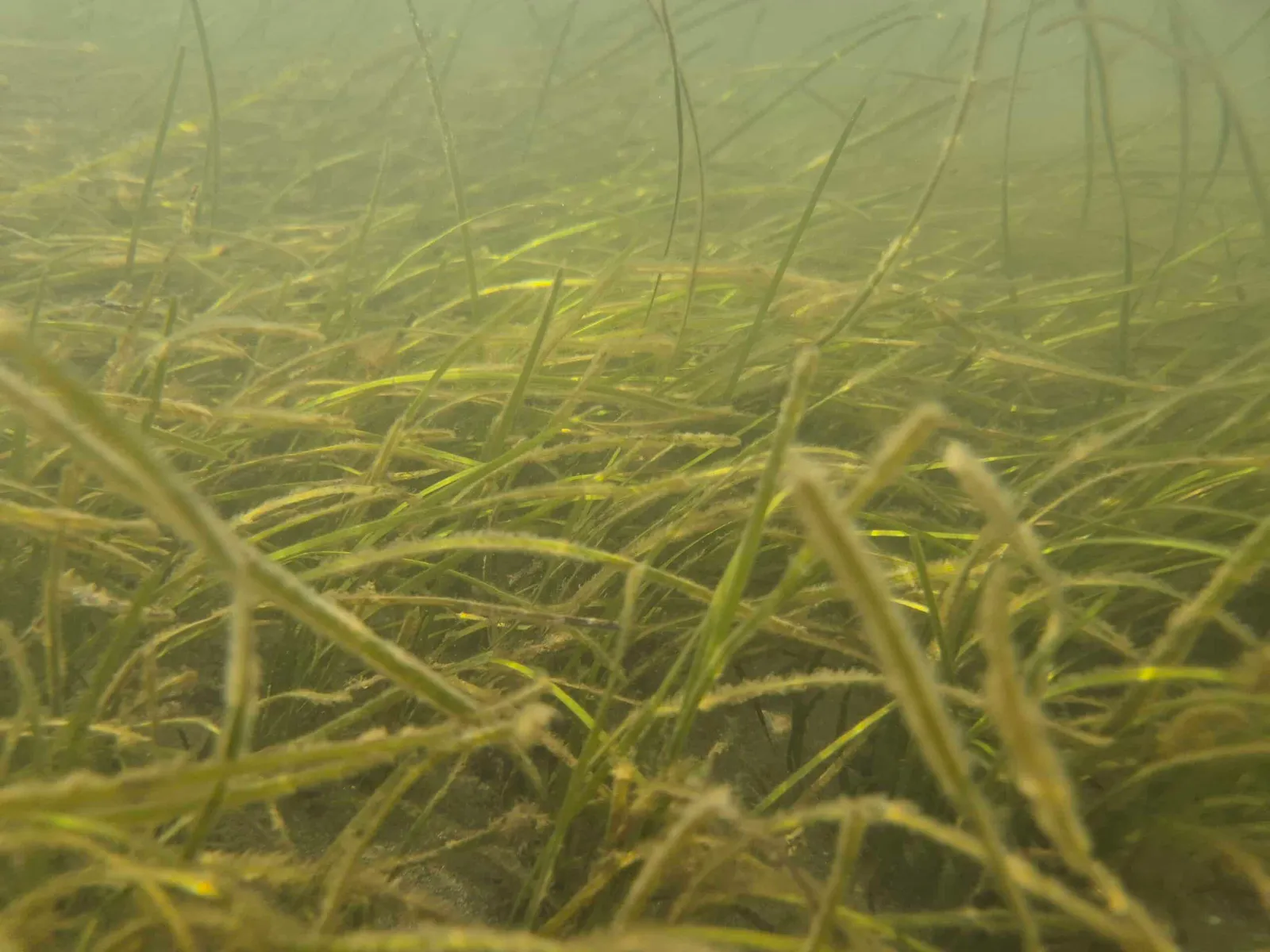
Under the surface of the Thau Lagoon extend nearly 2,400 hectares of seagrasses, among the largest on European coasts. These submerged meadows constitute refuges and breeding zones for many species, including seahorses and pipefish. However, their presence sometimes raises questions when leaves naturally detach and accumulate on the beaches.
The SMBT has been acting for over a decade to preserve these environments through ecological monitoring and consultation. In Balaruc-les-Bains, this approach translated into close work with municipal services to rethink certain beach interventions. Gradually, invasive practices were abandoned in favour of less invasive methods. The management of floating vegetation and stranded deposits now receives particular attention.
This change relies on dialogue and technical support, notably led by Camille Pfleger-Violette, Natura 2000 animator at the SMBT. The approach has continued for four years with the municipality of Mèze, where sand inputs on beaches have been halved. Balaruc-les-Bains, Mèze, and Bouzigues have thus engaged in a reduction of sand replenishment.
Over the years, work within the Natura 2000 framework has contributed to changing how different users of the Thau basin consider seagrasses. Today, their preservation is progressively integrated into the practices and projects of those who live and work around the lagoon. In ports, dredging or quay renovation projects must take into account their potential effects on seagrasses.
Regarding pleasure boating, regulations prohibit mooring in the 300-metre coastal band and in several sensitive sectors of the lagoon. The Écogestes Méditerranée campaign contributes to sensitizing boaters to good practices, particularly regarding anchoring. Organisers of sports and nautical events are also concerned with Natura 2000 impact assessments.