As part of the Fête de la Science (Science Festival), the University of Montpellier invites the public to discover "Moby Dick, the Whale's Eye." This creation by the company Belle Pagaille, in residence at UM from October 2025 to April 2026, revisits Herman Melville's masterpiece by illuminating it with current knowledge on cetaceans. The event is free and open to all, and will take place on the Triolet campus at 7 PM.
The show takes as its starting point the epic tale of Ishmael's journey aboard the whaling ship Pequod, in pursuit of the legendary white whale, Moby Dick. The company uses this narrative as a springboard to explore the world of cetaceans and confront Melville's imagination with contemporary scientific discoveries.
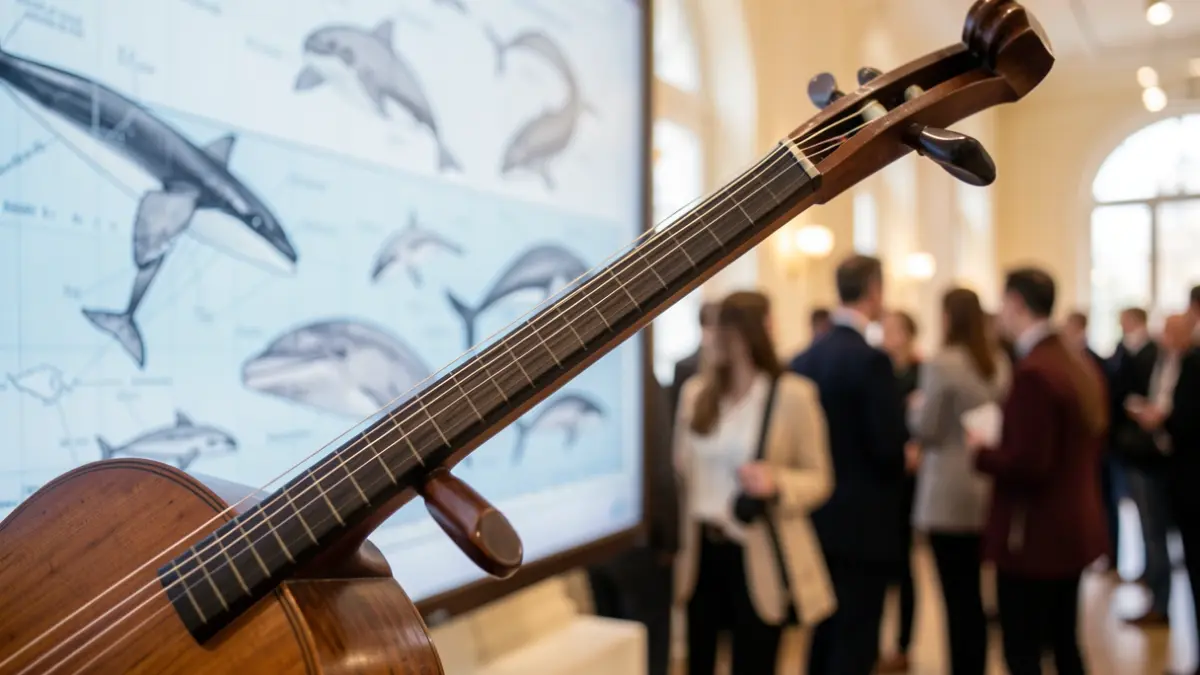
The creation, driven by minimalist staging, brings together an actress and a musician. It blends object theater, origami, sound effects, original sound compositions, and radio codes to create a poetic universe. Sounds captured via a hydrophone are combined with the unique vibrations of the Dan Bau, a traditional Vietnamese one-string instrument, which accurately reproduces cetacean songs, thus becoming the voice of the deep.
In collaboration with Aurélie Célerier, a researcher at Cefe and a specialist in marine mammals, the performance establishes a close dialogue with scientific research. Her expertise has helped anchor the play in current knowledge about the behavior and environment of sperm whales.
Prior to the performance, an educational exhibition, created in collaboration with students from the Integrated Biology of Marine Mammals course at the Faculty of Sciences (co-led by Aurélie Célerier and Bastien Mérigot), will also be offered to the public.
This evening promises a moment to dream, learn, and marvel.
Practical information: The performance will take place on Thursday, October 8, 2026, for all audiences, free of charge and by reservation, at the Campus Triolet, Building 5, Amphitheater 5.06. More information and reservations are available via the provided link.