
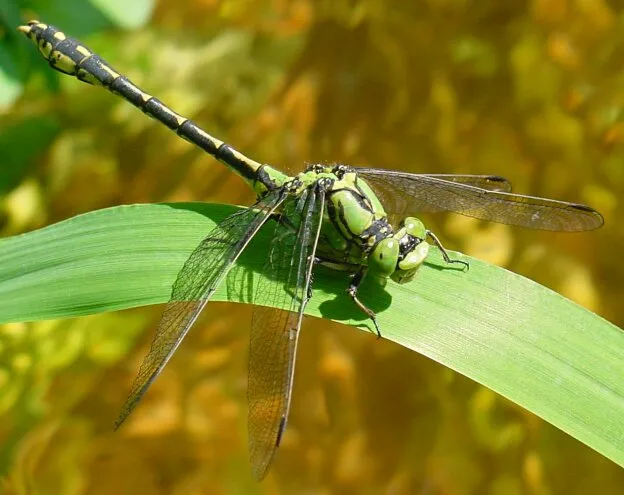
Baptiste Charlot, naturalist at the Conservatoire des espaces naturels d’Occitanie, described this discovery as a "very good surprise". This observation constitutes the first proof of reproduction of the serpentine gomphe (Ophiogomphus cecilia) in the Lot valley and throughout the Occitanie region. The nearest populations are located in the Allier valley, more than a hundred kilometres away.
This dragonfly is a species protected at the national level and classified as a species of community interest by the European Union, due to the strong regression of its populations linked to the degradation of its habitats. Its larvae develop on sandy bottoms for two to five years. Like all dragonflies, it requires a diverse and connected landscape, with adults hunting in terrestrial environments adjacent to watercourses, such as mown meadows, edges, and hedgerows.
In the Natura 2000 site of the Upper Lot valley, dragonflies are subject to periodic monitoring campaigns. Perrine Largarde, project officer at the Park, explained that three protected species are particularly sought after: the Graslin gomphe, the slender-bodied cordulia, and the splendid cordulia. Counting is done on exuviae, external shells shed during metamorphosis. Three years of monitoring were conducted between 2019 and 2021, and three new ones started in 2026. The SOGAP scientific protocol involves walking or canoeing five 250-metre riverbanks three times in spring and summer.
In 2026, nearly 1000 exuviae were collected. Eight different species were identified, including nearly 900 exuviae of the clawed gomphe (Onychogomphus forcipatus). However, none of the sought-after species were found this year. Bertrand Goguillon, head of the Natural Heritage department at the Park, emphasised that this monitoring is an essential scientific action to assess the health of the aquatic ecosystem, as odonates are excellent bioindicators of water quality and river health.
Dragonflies are considered "umbrella species" and super-predators of insects, particularly mosquitoes and horseflies. For there to be a diversity of dragonfly species, the entire food chain below them must be healthy. Thus, by protecting the habitats necessary for dragonflies, one indirectly protects a multitude of other species, such as amphibians, birds, and aquatic flora. On the side of the Cantal Aubrac Natura 2000 site, two heritage species were found this summer, but few individuals were counted, impacted by drought and heatwaves.