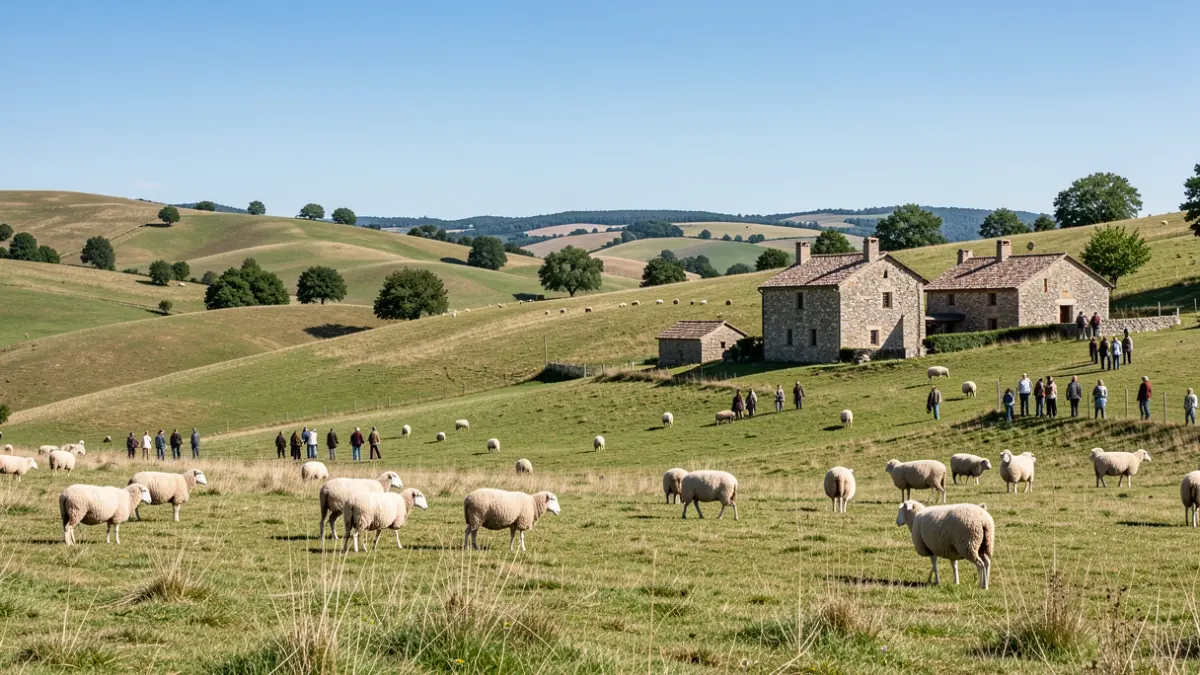
The town of Florac-Trois-Rivières hosted the Pastoralism Encounters from September 25 to 27, 2026. Organized by the Interdepartmental Association of Causses and Cévennes and the National Park, this event is part of the International Year of Rangelands and Pastoralists. These three days, including a highlight on Saturday, September 26, honored pastoralism professionals: breeders, artisans, producers, trainers, researchers, associations, local authorities, and territorial actors. The main objective was to promote an agricultural activity that has shaped the landscapes of the Causses and Cévennes for millennia, nourished the territories, maintained open environments, and enriched their biodiversity.
The encounters began with the show "Elevage" (Livestock Farming) by the company Les Animaux. The morning continued with a market of pastoral producers and artisans (wool and leather) in the town hall square, offering the public a chance to discover and taste local products. Among the exhibitors were the Ferme du Pas du Loup (ice cream), Olivier Fabre (sweet onions and potatoes), and Le Saltadou (honey), all beneficiaries of the Esprit parc national brand. On the esplanade, visitors engaged with numerous pastoralism stakeholders, including professional, institutional, and associative partners. The musical entertainment was provided by the Batucada Santudobem.
Current issues in pastoralism, such as local supply chains, predation, new farmer installations, and agricultural income, were central to discussions during two round tables. The introduction to these exchanges was presented by Benoît Dedieu, research director at INRAE. A conference titled "Climate and Pastoralism in Causses and Cévennes", led by Vincent Cailliez, climatologist for the network of Chambers of Agriculture of the Massif Central (SIDAM), highlighted the impact of climate change on livestock farming conditions and the availability of pastoral resources.
Practical demonstrations allowed the public to experience the daily life of breeders, featuring sheepdog handling demonstrations, animal care, and the presentation of local sheep and goat breeds. Several exhibitions were also displayed throughout the town, including "Pastoral Diversities", "Transhumances", "Tour de France of Pastoral Landscapes", "Female Breeders and Shepherdesses in the Cévennes" by Laurine Habert, "Local Breeds" at the Interpretation Center of the UNESCO Site House, and a sculpture exhibition by local schools in the former courthouse.
Finally, farm visits offered a concrete insight into the lives of farmers. Participants discovered the work of sheep breeders Guilhem Roux (GAEC de l'Hort à Solpérières, Vébron) and Lisa Thomas (Ferme de Rampon, Bédouès-Cocurès), as well as cattle and sheep breeder Yves Commandré (GAEC La ferme de Louisou, Le Pont-de-Montvert – Sud Mont Lozère).