
Thermoplastic composite materials offer significant potential for creating lighter, repairable, and recyclable structures. However, their manufacturing is hindered by the high viscosity of polymer matrices in the molten state, making homogeneous impregnation of continuous fiber reinforcements difficult. In a drive to reduce environmental impact, a thesis explores an original strategy: valorizing recycled polyethylene terephthalate (rPET), derived from post-consumer waste, as a matrix for thermoplastic composites produced via a solvent-based process.
The work relies on a dissolution-precipitation process. This method dissolves PET in a suitable solvent, impregnates a fibrous reinforcement with the resulting solution, and then precipitates the polymer directly within the reinforcement using a non-solvent. This approach aims to reduce high-temperature processing steps and facilitate matrix penetration into fibrous structures. Scientific challenges were addressed at various scales: the recovered polymer, the impregnation solution, the fibrous reinforcement, and the continuous manufacturing process.
Initially, PET recovery via a solvent-based route was investigated. Hansen solubility parameters and phase separation mechanisms were used to select solvent/non-solvent pairs. The Hexafluoroisopropanol (HFIP)/ethanol system was chosen, enabling PET dissolution at room temperature while preserving its properties. Impregnation mechanisms were then analyzed based on the physico-chemical properties of HFIP/PET solutions, examining density, viscosity, and surface tension in relation to capillary wicking kinetics in carbon fiber reinforcements.
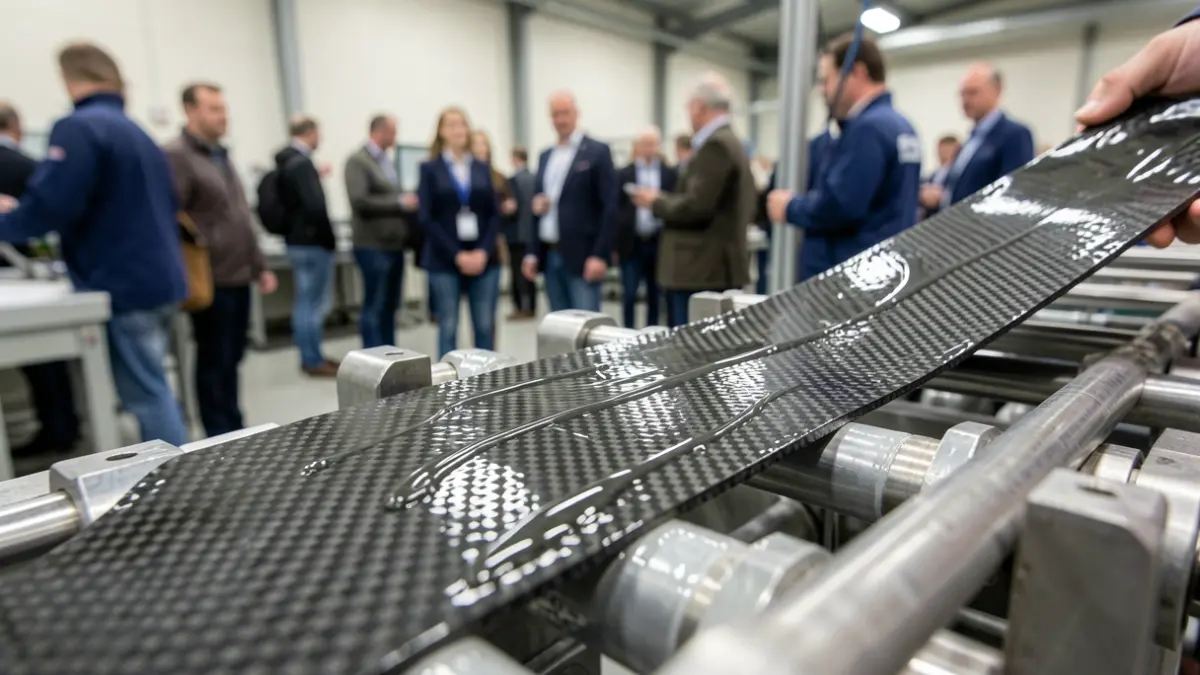
These findings led to the design and optimization of a continuous pilot impregnation line for manufacturing carbon/rPET tapes. The process was subsequently adapted for bio-based flax fiber reinforcements. Surface properties of the fibers, PET, and solutions were characterized to understand interfacial interactions. Two flax architectures were compared, demonstrating the influence of reinforcement geometry on tape morphology and composite mechanical properties.
The process circularity was also assessed through multiple cycles of manufacturing, PET matrix redissolution, and flax fiber recovery. Analyses indicate that the recovered fibers retain their properties after several cycles, highlighting the potential of a reversible process combining a recycled matrix, a bio-based reinforcement, and an integrated end-of-life strategy.