Continuing explorations initiated in 2025 and 2026, teams from the Seaquarium Institut Marin recently dived into the Camargue waters near Le Grau-du-Roi. This expedition aimed to document the nocturnal plankton life, following up on Black Water observations conducted locally.
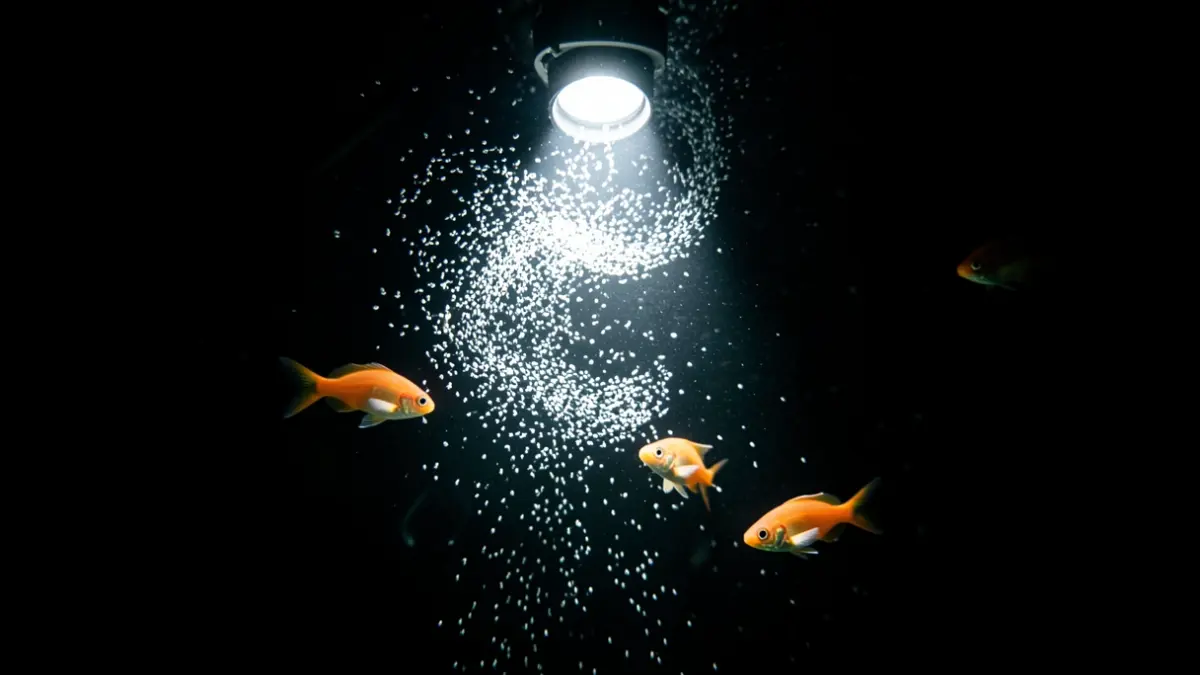
Before the dive, the teams observed tuna hunting at the surface, taking advantage of the golden light of the setting sun. Once night fell, spotlights installed under the boat served as visual anchors for the divers. They submerged for 77 minutes in water at 19°C, exploring from the surface down to 100 meters deep.
The Black Water diving technique involves night dives in open water, above deep seabeds. Without fixed visual references, scientists and photographers can observe the nocturnal vertical migration of plankton, as many organisms ascend from the depths to feed near the surface.
Around the boat's spotlights, divers, guided by their lamps, observed and photographed a tiny yet rich biodiversity. Unlike previous outings, benthic and pelagic fish post-larvae were discreet, with the notable exception of young apogon (Apogon imberbis) with their large orange eyes.
The procession of non-fish plankton proved exceptionally rich. Divers identified and photographed siphonophores, such as the spectacular Physophora hydrostatica, with their gelatinous structures and stinging filaments. They also observed micro-zooplankton, including micro-jellyfish, pelagic shrimps, and radiolarians.
These observations enrich local scientific databases and contribute to the census of marine biodiversity via platforms like iNaturalist. Plankton, an essential link in the food chain, is closely monitored to understand its seasonal evolution in a rapidly changing era.
The exhibition 'The Night of Plankton', featuring 24 large-format photographs taken in night vision, is available for free discovery around the Seaquarium Institut Marin until November 3, 2026.