The European CLAM-EU project, supported by the Horizon Europe – Mission Ocean program, has reached a key milestone three months after its launch. Led by the University of Montpellier, in partnership with Ifremer and artists Stéphanie Elbaz and Françoise Dagorn, this interdisciplinary project aims to raise awareness about the decline of the European clam (Ruditapes decussatus) and explore avenues for its restoration. The initiative combines scientific research, artistic creation, and citizen participation.
Since September, three participatory workshops have been held, bringing together students from the Lycée de la mer de Sète, citizens of different generations, fishermen, teachers, managers from the Syndicat mixte du bassin de Thau, and scientists. These workshops began with discussions on scientific knowledge and the history of clam fishing, before inviting participants to translate this information into musical and pictorial creations.
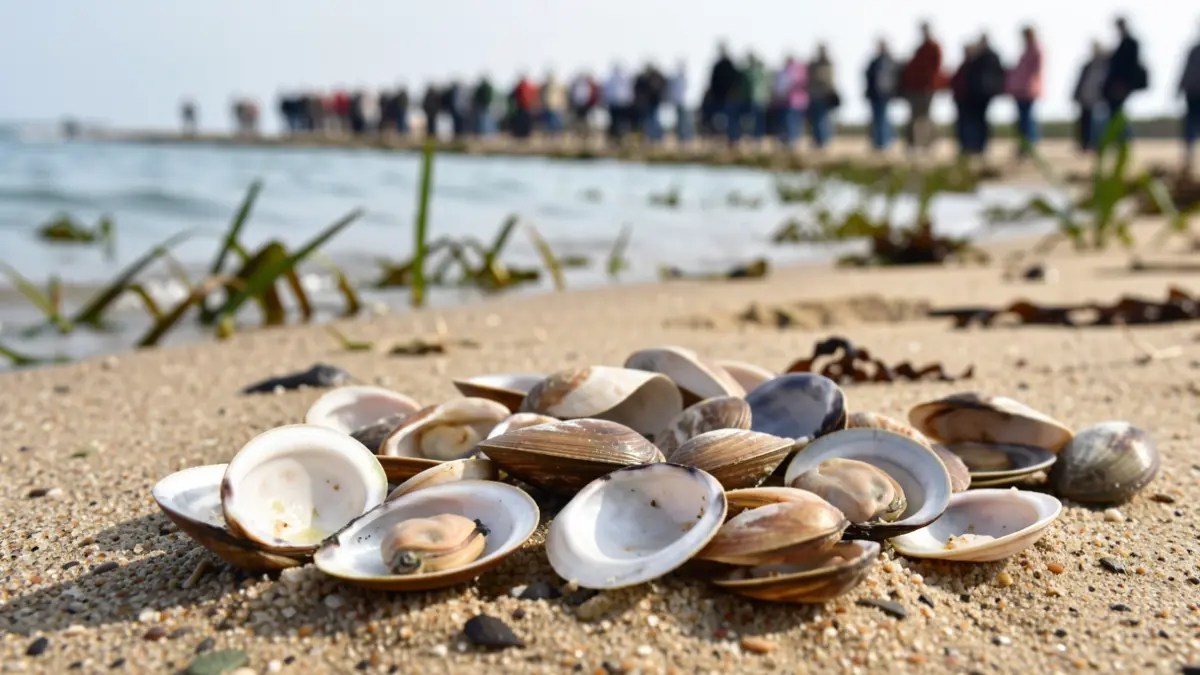
Under the direction of pianist Stéphanie Elbaz, clam shells have been transformed into sound objects, and water used as an instrument, creating an original composition evoking the fate of this shellfish. In parallel, visual artist Françoise Dagorn has guided participants in painting workshops, using marine charts and scientific publications to explore the transformations of the lagoon, resulting in eight artworks to be presented at the final exhibition.
Alongside the artistic activities, the scientific experiment Careshell, inspired by a Japanese method, is underway in the lagoon. Experimental devices comparing nets with crushed oyster shells to control devices are deployed to assess their potential for the recruitment and development of the European clam. The results of this experiment, coordinated by Franck Lagarde (Ifremer) and Bastien Mérigot (University of Montpellier), are expected in early November.
CLAM-EU is also implementing a participatory evaluation system to document participants' experiences and the evolution of their perceptions and knowledge. The project's achievements will be presented to the public on Thursday, December 3, 2026, from 6 PM to 8 PM, at the Pôle universitaire Michèle Weil in Sète. The event will include a scientific conference, a concert, and an exhibition of the pictorial works, which will remain accessible until December 11. CLAM-EU will also be presented at the PartArt4OW Demo Days in Barcelona on December 17 and 18, 2026.