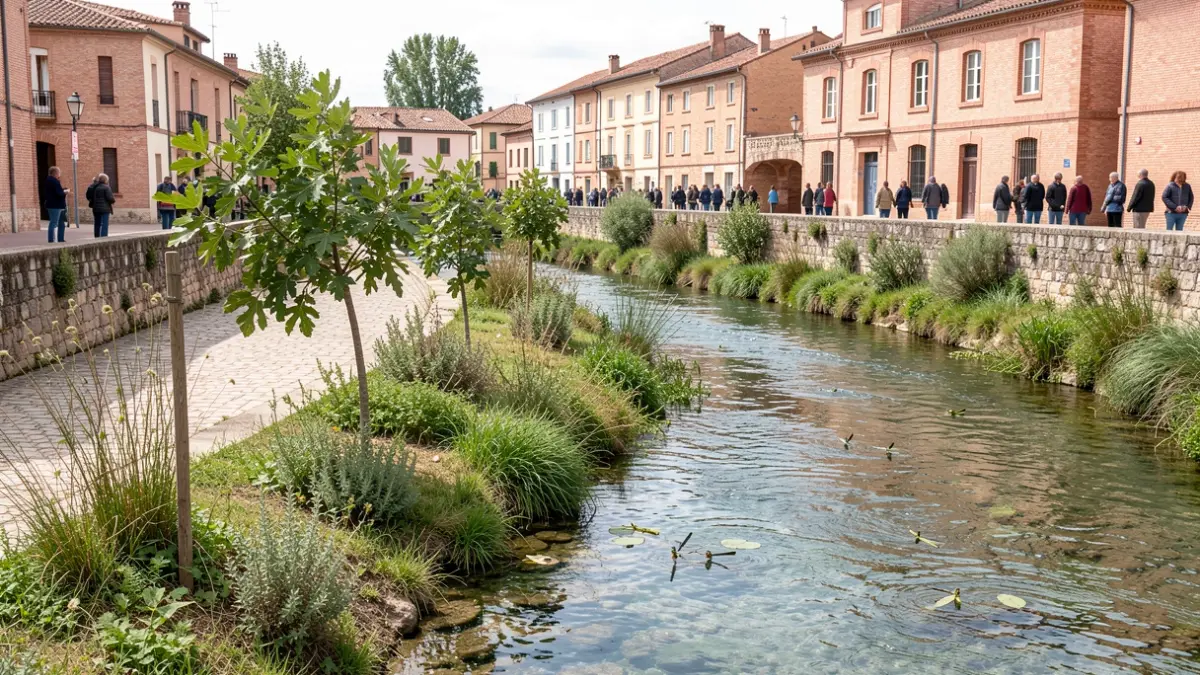
Vegetation management work on the Vène river has recently been completed in the center of the village of Montbazin. The objective is to maintain good water flow while preserving the biodiversity and natural functioning of the watercourse.
The vegetation of the Vène is regularly monitored and interventions are adapted to the sector's challenges. The principle is to intervene only when necessary, removing elements likely to cause problems while conserving vegetation beneficial to the watercourse. Work can therefore differ from one year to the next, depending on vegetation evolution, observed flows, and the characteristics of each sector. These interventions are carried out within the framework of GEMAPI (Management of aquatic environments and flood prevention), a competence exercised by Sète agglopôle méditerranée, with the technical support of the Syndicat mixte du bassin de Thau (SMBT).
This approach is part of a broader evolution in river management, which now favors observing the watercourse's functioning and targeted interventions. Vegetal engineering, the conservation of certain vegetation areas, and 'low-tech' regeneration techniques are part of these new approaches, which prioritize natural processes and the use of on-site materials. References such as 'beaver-type structures,' inspired by natural beaver dams, use wood and vegetation to locally influence flows and promote greater habitat diversity.
In Montbazin, elements likely to hinder water flow during rising levels, particularly some young fig and ash trees, have been removed. Particular attention was paid to areas near bridges and storm drain outlets. Elsewhere, grasses and small shrubs have been intentionally conserved when they do not impede flow, as they provide favorable habitats for numerous species, such as frogs and dragonflies.
Leaving some vegetation in place is not a lack of maintenance. A watercourse entirely cleared of its vegetation does not necessarily function better. The presence of vegetation, roots, or wood can contribute to the diversity of flows and habitats. The challenge is therefore to determine what truly needs to be removed and what can be conserved. The evolution observed last winter, where a small channel gradually formed in the center of the Vène riverbed, shows the watercourse's capacity to evolve naturally when interventions are targeted.
The management carried out in Montbazin seeks this balance: intervening where water flow issues require it, while leaving the Vène the necessary space to evolve naturally.