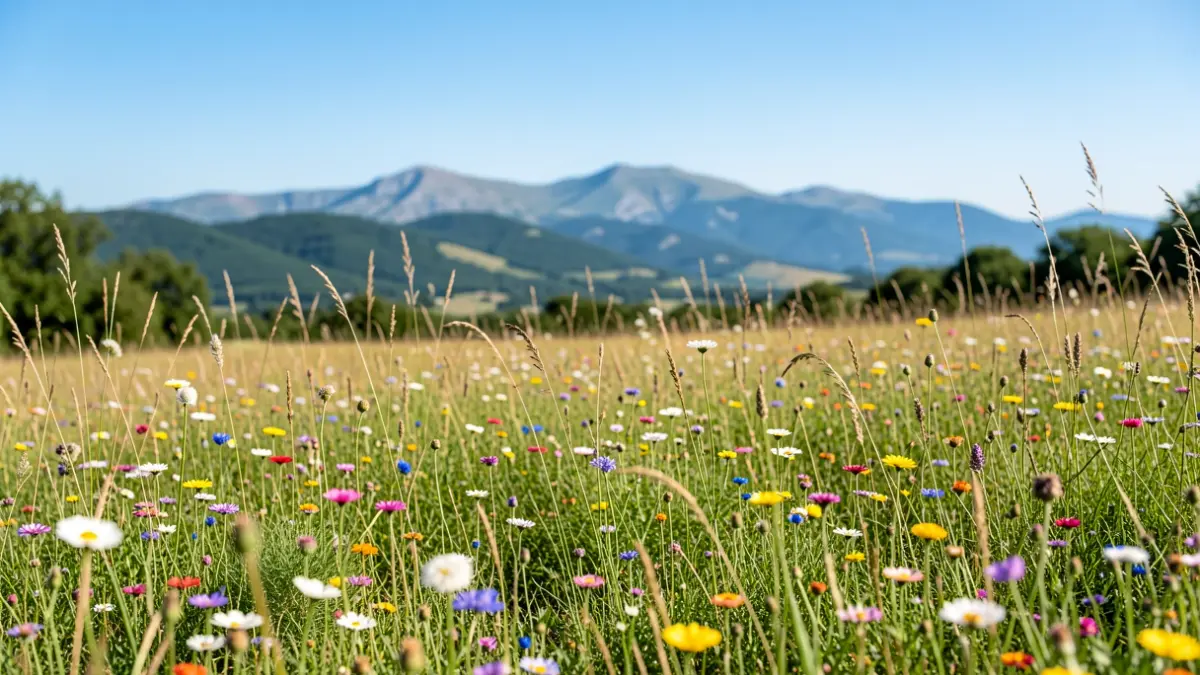
A global research project on grasslands, a vital natural environment for biodiversity, livestock fodder production, and climate change adaptation, has been launched. A field exchange event was held in Saint-Urcize between farmers and partners.
"The grassland is the most diverse natural environment," explains botanist François Prud’homme. He highlights the presence of up to 100 different plant species, some rare, and their ability to withstand intense climatic conditions, thus justifying the resources mobilized for this study.
Led by INRAE Clermont-Ferrand and the National Botanical Conservatories, this project will analyze 150 plots in the Massif Central for at least 10 years, including 15 in Aubrac. The goal is to understand their functioning, their impact from climate change, their resilience, and to identify best practices for farmers.
The project relies on local partners. In Aubrac, the Regional Natural Park has gathered farmers to connect scientific research with practical knowledge. "We also aim to foster cross-disciplinary perspectives, transversality, and territorial emulation between scientific data and traditional farming knowledge," specifies François Prud’homme.
"We hypothesize that grassland biodiversity... are levers for sustainable grass production," explains Julien Pottier, a researcher at INRAE. Numerous monitoring activities are planned: botanical, insect, soil, farmer practices, satellite imagery, and weather data.
"Few studies cross-reference agricultural and ecological knowledge, and this is a strong ambition of this program," insists François Prud’homme. Specific farmer questions will be studied, particularly concerning narcissus-rich grasslands and manure quality in Aubrac.
One farmer testifies: "Here, we have never plowed this plot... our cows have grazed here since April 28th and still have plenty to eat today." Others, like Robert Dardé and Thierry Champagne, express concerns about climate change and their hopes for this project to better manage their farms.
The collected data will be made available annually to farmers and project partners. Initial interpretations are expected within 3 years, with a scientific publication planned for 2029.
The Grassland Observatory is funded by the Auvergne-Rhône-Alpes Region, DRAAF, FNADT, OFB, PEPR Sols Vivants, and led by INRAE Clermont-Auvergne and the National Botanical Conservatories. The participation of the Aubrac Regional Natural Park is supported by the State's Green Fund and the Adour-Garonne Water Agency.