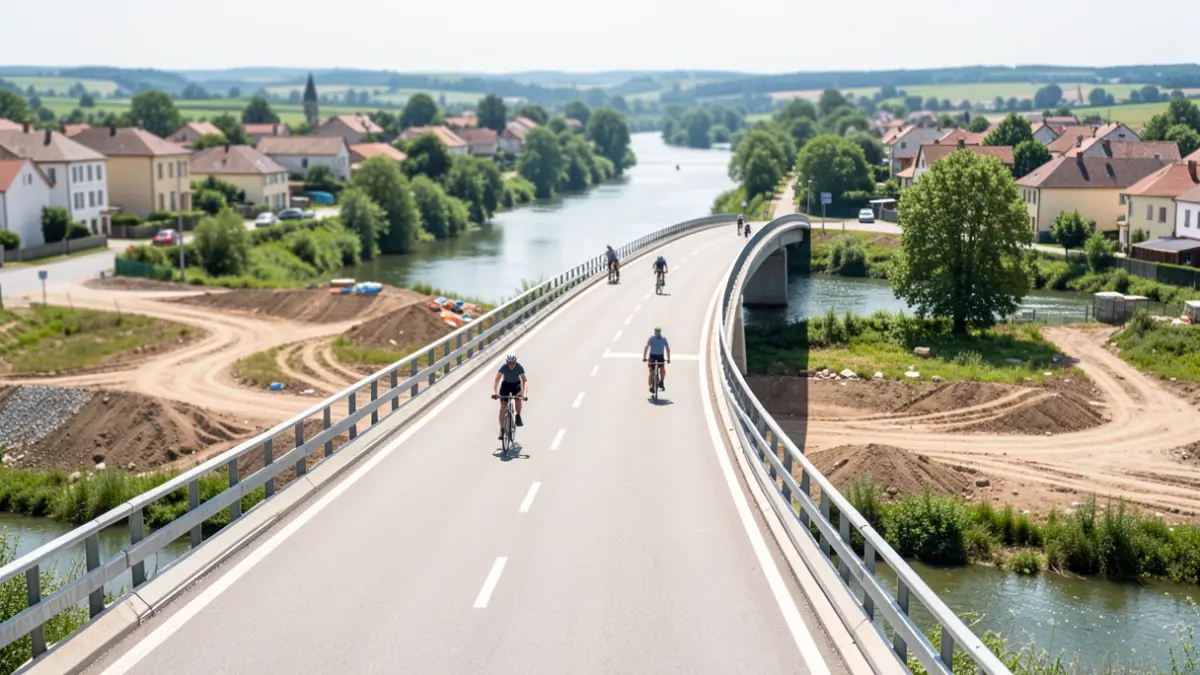
After several months of work, the new structure, designed for durability and to accommodate all modes of transport, replaces the old, dilapidated bridge. This route, used daily by approximately 4,000 vehicles, is now safer.
The new bridge measures 90 meters in length and 12 meters in width, with 3 meters reserved for cyclists. Its framework weighs 240 tons. The construction involved recalibrating the D11 over 1,825 meters between Sainte-Marie-la-Mer and Canet-en-Roussillon, with earthworks, sanitation, and road surfacing carried out from April to November 2026.
The project also integrates soft mobility with 230 meters of cycle path accessible upon the bridge's opening. A new 530-meter section in its own right-of-way is planned in the coming months, followed by connections to surrounding cycling infrastructure.
To minimize environmental impact, the Department prioritized recycled and low-carbon materials, reducing natural resource consumption and CO2 emissions. The construction site was organized to preserve resident access, with work conducted off-peak and in half-lane sections, using a diversion via the RD81.
This project, entirely led and financed by the Department of Pyrénées-Orientales, was acknowledged by the City of Canet-en-Roussillon. The municipality also thanks the companies, the mobilized teams, as well as the residents and users for their patience.