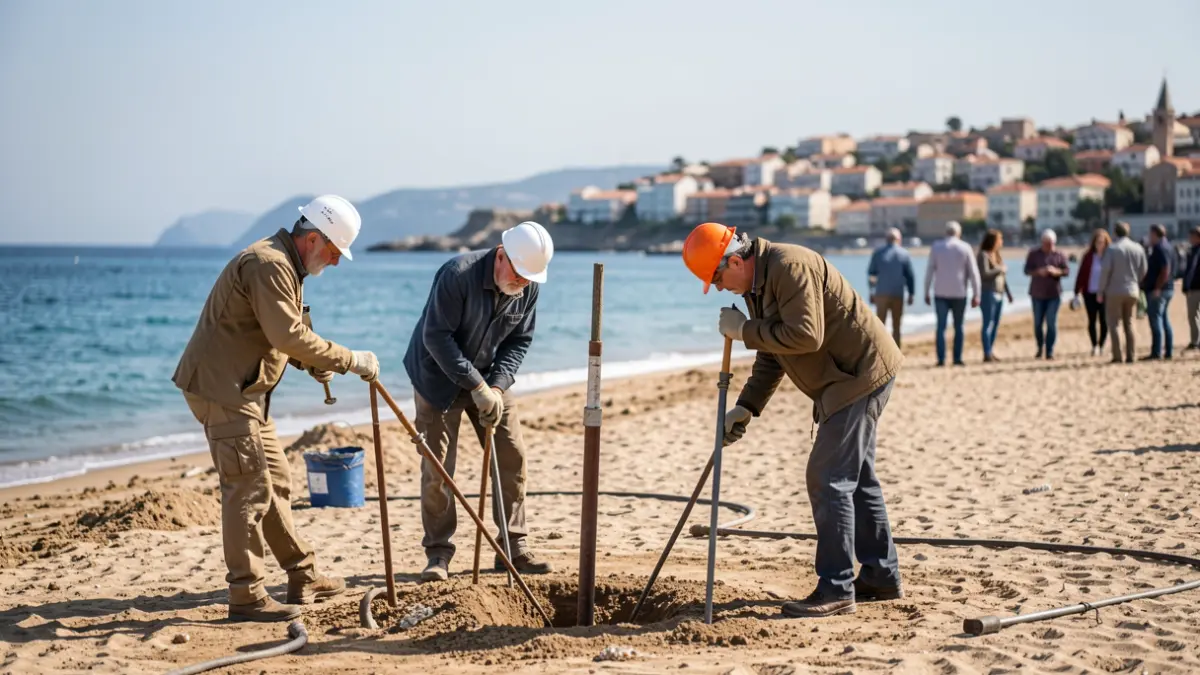
A multidisciplinary team of scientists is conducting a first phase of archaeological tests from September 28 to 30 on the beach of Frontignan, near the Front de mer impasse (access 25). The objective is to prepare for a larger upcoming intervention, searching for traces of very ancient human presence.
For three days, researchers are performing methodological tests and core sampling to detect potential traces of human presence dating back to the Neolithic period, approximately between 6000 and 2200 BCE.
This initiative originated in January 2026, when archaeologist Claire Manen, a research director at the CNRS and a specialist in prehistory, discovered with municipal archivist Carole Briffaud a collection of nearly 600 pieces of Cardial pottery shards stored in the museum's reserves. These artifacts, washed ashore by the sea in the early 2000s, had not been archaeologically researched until then.
Following this discovery, Claire Manen assembled a team of eminent scientists: Benoît Devillers (geomorphologist, University Paul Valéry of Montpellier), Thibault Lachenal (protohistorian, ceramologist, CNRS), Frédéric Leroy (heritage curator, DRASSM), and Clothilde Melon (PhD student). This multidisciplinary team aims to deepen research to understand the beach environment, landscape evolution, and potential evidence of ancient human presence.
Specifically, the team is conducting core sampling using an auger and percussion corers to collect samples from over 3 meters below sea level. « We hope these tests will be conclusive and lead to broader investigations in the near future, perhaps even an underwater extension, » explains Frédéric Leroy. Benoît Devillers adds: « For now, we are at 3 meters below sea level; the idea is to go down to 9 meters ».
Following this initial investigation phase, analyses will be carried out, and a prospecting report will be produced. Based on what the scientists find in the samples – shells, plants, seeds, pollen, charcoal remains – the team will determine the next steps for research.